In the Ballard neighborhood of Seattle, Salmon Bay Park extends to the equivalent of four small blocks of rolling landscape with tall evergreen and deciduous trees and grassy areas. It has a playground, a few picnic tables, and toilets, which are sometimes in bad shape. Many families use the picnic tables to celebrate children’s birthdays, when they meet in large groups. Adults stand around talking and children play games or romp around the playground. People bring far more food than even a party crowd can eat, and the trash cans are full when they leave.
On Sunday evenings, a t’ai chi group of maybe eight or nine people meets in the western area of the park and practices a kind of stiff, awkward version of Yang style. At other times, a trio of musicians comes together under a tree. They play from sheet music clipped to music stands so the wind won’t blow it away. Almost always, a gentle wind blows eastward from the shore, even on very hot, stony days. In the summer, most of the single-family homes surrounding Salmon Bay Park are likely much warmer than the park, but one doesn’t see people using it as an outdoor living room where they talk, read, eat, do crafts, play chess, or whatever people do in their houses.
We’ve come to Salmon Bay Park for many years to get a break from the heat in our part of town, for picnics with friends, or to rest on a bench during a long walk. It can feel miles away from the harsh, always transitional city and its horrible traffic. On a recent, boiling Saturday, we brought our folding chairs and table to sit under a big tree whose trunk and roots were splattered with resin. The folding chairs are more comfortable than the park’s filthy picnic tables, all of which were in any case busy with birthday parties. While we sat and read, a handful of people passed, most of them walking dogs. I hiked to the Ballard Market to get sandwiches and potato salad, a stupid idea because it was too hot to enjoy walking. I was glad to be back under the tree, where we ate the food and read a little more.
I was coming to the end of Die Wand by Marlen Haushofer, translated from her Austrian German under the title The Wall and recently re-published for English-only readers. I’m from Köln — “Cologne” — and have lived abroad for much too long, but found the novel easy to take in, without any puzzling Austrian terms I had to look up. It flows beautifully and somewhat monotonously, like a Schubert symphony. It ends calmly, with the protagonist getting ready to feed a white crow whose trust she has won recently.
The plot is simple. An unnamed woman finds herself alone in a rustic cabin in a remote, forested area where people come to hunt. She discovers that she cannot leave because an invisible, impenetrable, transparent wall makes that impossible. She finds that water can find a way under the wall and plans to build a passage allowing animals and maybe even herself to cross. She does not act on this when she understands that all life outside of the wall has ceased and it is not safe to leave its confines. She survives by growing potatoes and green beans, and also hunts deer. After about the first third of the book, the wall is hardly ever mentioned anymore.
Animals provide the protagonist with companionship and support. A loyal dog becomes a trusted friend. When she finds a cow, she relieves her of the pain of not being milked for too long. The cow’s milk becomes a crucial part of the woman’s diet. Eventually, the cow gives birth to a bull. A cat joins the woman and has a litter of kittens after finding a mate in the woods. Not all the young cats survive in the wilderness.
Through the course of about three years, the woman and the animals migrate to a high mountain meadow during the summer, then return to the original cabin for the winter. The woman grows her rudimentary agricultural and husbandry skills, learns how to use her hands as tools, and becomes expert at tending her crops and taking care of the animals. When suddenly a man appears and kills the young bull and the beloved dog, she shoots him and rolls his carcass off a cliff. She and the remaining animals — the old cat and the cow — carry on. The cow even gets pregnant once more. The woman writes the report we’re reading and stops when she runs out of paper. She has enough supplies to last another couple of years.
The novel would simply be a tedious chore to read if the language weren’t as unassumingly beautiful as it is. Every phrase in every sentence follows a consistent rhythm and maintains a certain harmony, an undertone of the inevitable suchness of things that is neither good nor bad. From time to time, the woman briefly reflects on her life, during which she maybe experienced some kind of trauma, but certainly sadness and a sense that she was never quite able to spread her wings. She feels a compassionate sadness for the many millions of dead outside of the wall. She does not obsess about herself and her unusual fate. When she experiences wonder and joy, she does so without exaggeration or verbosity, nor does she get carried away by her emotions. She does not fight what she cannot overcome, but neither does she give up and live in resignation. She assumes responsibility without guilt and allows herself long periods of rest without falling into apathy. When evil intrudes, she stops it and grieves the deaths it wrought, but won’t be overcome by despair. Until the end of her narrative, she keeps engaging with life and taking the best possible care of the animals and herself.
Sometimes, I imagined the novel recast from a conventionally male perspective. No doubt the protagonist would for far too long attack the wall with whatever tools and objects he could find, not giving up until he had injured himself or almost lost his mind. He would maybe try to climb up on it, or spend many pages designing some sort of signaling system to get in touch with anybody still alive outside. He would obsess about the identity of whoever placed the wall and attempt to reach them by heroic means. He would want to dominate the animals instead of forming a kind of family with them. Of course, when a threatening intruder appears, the two men will fight to the death. In short, that male lens would deliver all the elements that make movies and novels annoying and predictable.
Thankfully, Die Wand wasn’t like that.
Die Wand was a powerful, overwhelming experience, a little like hearing Mahler’s Ninth Symphony for the first time or reading the Diamond Sutra in a good, contemporary translation. Its bleakness, the endless monotony of the woman’s everyday chores, her entrapment and the uncertainty regarding a viable future never mar its beauty or the richness of life that is still possible. Instead, it reveals a gorgeous, fundamentally benign and alive universe that comes alive with understanding, forbearance, and letting go of whatever is not helpful. I felt like Haushofer’s writing reached into my heart and tore a little opening.
As far as I know, my mother never wrote anything except short letters and postcards. She expressed her creativity in making costumes and drawing. If she would have been called to write, I imagine she would have come up with something like Die Wand. Like the life of the woman in the novel, hers was governed by necessity, loyalty, love, and acceptance. Work absorbed at least six days a week until her death at fifty-four. Much of it was unpleasant and difficult. She didn’t give up until the very end, without ever becoming cruel or cynical. Most people who knew her would have described her as friendly, insightful, tireless, kind, and funny. The life she lived was far from what she once aspired to, but she never turned dark, not even when her parents for decades treated her with extreme cruelty.
I’ve been thinking about my mother as I’m anticipating a journey to Köln and wonder what I really knew of her. I will always have to live with the wound of not being able to talk with her, of her dying before I was an adult who could meet her on a similar level. Reading Die Wand felt a little like her mind and voice were there, ever so lightly trying to reach me, on the pages and in the park.
There’s no prescription in this. Die Wand or The Wall may leave you cold, but maybe there are other things that touch you deeply. The way a crow swoops down on you as she defends her nest, a tabla player on a tiny boat drifting in the middle of a lake, the feeling of somebody’s hand on your shoulder. Almost anything could unfreeze and open your heart, as long as you’re awake and available. Don’t let the wall win.
A young man with a French bulldog approached on the path near the tree. The dog stopped and refused to walk one more step. Then she pulled on the leash until he let her walk on the grass. He followed her when she came over to me, lightly leaned against my leg, and turned her face up toward mine. The poor dog could barely breathe — thanks to inhumane, cruel breeding for money — and seemed miserable in the heat. She looked at me with a helpless, confused panic in her eyes. She let me touch her; I felt her body trembling. The young man and I exchanged a handful of words. When he slowly moved on, the dog turned away and followed him.
Recently, I bought a barely used Third Edition of Roget’s Thesaurus at a garage sale in Chehalis, where I had stopped for a break on an exhausting drive from Portland to Vancouver, B.C. The story that follows had been typed on four single-spaced, folded sheets that fell out of the book when I opened it at home. The unknown amateur writer probably created this odd, highly derivative story close to the first publication of the Third Edition in 1962. I hope that his writing, mawkish and unpolished as it is, helped him deal with the sadness and grief that he seemed to have a hard time keeping at bay. I inserted paragraph breaks and corrected typos, but otherwise left his stilted verbiage alone. If it helps you ask a question or uncover a dream of your own, it has achieved more than could be reasonably expected.
Three unforgettable nights
Some time ago, after our son went to India and was never heard from again, Mary, my wife, and I took two cats into our house. They lived with an old man who sailed his model boats on the pond in Torpenady Park. where we often saw him. He couldn’t care for them anymore after a stroke had blinded and partly paralyzed him. Said to be about two years old, they were shy when we first met them. We didn’t even see them well, just enough to notice that they were both small tabbies. One of them seemed to be a little braver and more curious than the other. They might have been in shock after the recent changes in their home. His daughter, who had been good friends with our Penelope when she was still alive, implored us tearfully to shelter and feed them “to honor those we love.”
Both cats were males, neutered and apparently in good health. When we brought them home, they went into hiding in Penny’s former room, and we didn’t see much more of them for weeks. They ate and used their boxes near the laundry station in the basement. When one of us was down there, they hid behind a stack of suitcases. We called them Giorgio and Pietro.
Eventually, they began exploring the house. They played and chased each other through the rooms and up and down the stairs, but kept away from us. We didn’t hear their little voices until toward the end of the second month. When we saw them, they looked back at us with great intensity, but without curiosity. They never responded when we tried calling them. They ate when my wife and I weren’t nearby, but usually left food behind, not like other cats who gobble up whatever you serve them.
I wondered what was going on with these two. They weren’t like any of the other cats I’ve shared most of my life with. Sometimes, when I was awake in the middle of the night and curious what they were doing, I got up and went downstairs to the living room. Every time, they sat or lay on either end of the couch near the picture window, surprised but not startled.
What if the opera is in trouble?
One night in October, I rose because I heard some kind of shriek, or maybe laughter. I was walking down the plush, carpeted steps when it occurred to me that it was a better idea to watch Giorgio and Pietro from the landing halfway.
I did not see them. But two large persons sat on the couch. One was a dark-skinned woman in a sleeveless maroon dress. She wore a necklace made from light red and orange slivers of coral and similar bracelets on each wrist. Her feet rested on top of silver-strap sandals. I could not see her face, because she wore a tiger mask. It was so realistic that the eyes appeared to be following the outlines of the drawings in the book she held with both hands. The tiger fur covered her entire head and somehow blended into the umber skin just a finger’s breadth above the coral necklace.
The tiger mask moved in a convincing, natural manner when the woman spoke. “The opera had to cancel Rheingold next season because they’re unexpectedly short of funds,” she said. “Maybe we should donate some more. It’d be a shame.” Her voice was in a very low range, and her accent reminded me of South Africans I met when I traveled the country to purchase tea for packaging and resale at Clarkston.
The other individual was a man, judging from his grunt of approval and his figure. He wore a beige three-piece suit with some kind of large, blue marble fixed to the lapel. The skin of his hands and bare feet was almost the same color as the suit. I couldn’t see this man’s face, either. He wore a lion mask fringed by a generous mane. It made his head appear very large and looked as natural as the woman’s tiger disguise.
“I’ll call Rodolfo tomorrow,” the man said in a hoarse bass voice. “He can get a transfer going. I need to talk to him about stopping the support payments to Mrs. Woughlerby, anyway. She needs to get back on her own two feet.”
“It’s a little disappointing that they haven’t thought to call on us, don’t you think?”
He chuffed. “You can be sure they haven’t forgotten us. Maybe they think we’re tapped out.”
“Infuriating,” the tiger woman said. Long black claws shot from her fingers when she stretched her hand out on the armrest to her left. “That conductor never even said hello at the preview gala.”
“He’s an arrogant young man. Too much success, too soon.”
I didn’t know if these two would be glad to see me or if I should better head back upstairs and lie down. The man rustled with the newspaper on his lap. Judging from the fonts, the lack of color, and the yellowed paper, it was several decades old. I was glad that the noise covered the tiny squeak in the floor I caused when I shifted my weight.
They had heard it, though. Both raised their heads just a little. The woman stared in my direction, but didn’t seem to notice me, or chose not to let it show. “I don’t even like Rheingold all that much,” she said. “It’s not all that long, but still gets plenty tedious.”
The man yawned like a lion in an animated movie. I saw his huge teeth and his large tongue. “I like it when the giants stomp in,” he said. “I like their names, too. I always thought they were intriguing.”
“If we had kids, we could call them Fasolt and Fáfnir,” the tiger said. She made a coughing sound that was maybe a laugh.
“It’s a bit late for that, though. And they would probably find these names ridiculous.”
“So we’d have middle names for them. Like Cleo and Charles.”
He said, “That sounds a lot more like kittens. But it’s water under the bridge, just like what I’ve been reading. How come we buy a paper and it’s from 1921, anyway?”
“I thought something wasn’t right when I got out of the car at the service station while you were chatting with Donald. When I crossed the street to visit the newsstand, I almost fell over the small man who was passed out by the curb. Everything in the little shop was old and dusty. The gentleman behind the counter couldn’t have been more than twenty, but they didn’t even have a proper cash register, just a portable set of drawers with brass knobs to keep coins and banknotes. I’ve never seen anything like it.”
“We should see what other publications and refreshments they sell,” said the lion man. “Might be interesting, don’t you think?”
The tiger woman sighed, or maybe she suppressed a sneeze. “Maybe. But we might not even understand what we’re looking at. Let alone why.”
“You’re right. And of course we won’t be here long.” The lion man yawned again and shook his mane. “I’m sleepy.” He threw the newspaper to the floor and lay down on the couch with his back facing out. A lion’s tail stuck out of an opening in his trousers. It swished in the air a few time and then came to rest curled around him.
The tiger woman turned back to her book, but I was sure she was aware of me and every anxious breath I took. I decided not to push my luck. I returned to the bedroom as quietly as I could, holding my breath until I felt safe.
Both cats were on the couch when I got up a few hours later and went downstairs. They didn’t pay any attention to me, but ate heartily when I fed them.
From time to time, I went down to the landing when I had a restless night and was curious about what Pietro and Giorgio were up to. Nothing remarkable happened. Sometimes I saw both, one, or none of them. When the cats were there, they slept, groomed themselves, or rested, gazing back at me.
Preparations for a spectacle
One night in March, I woke up and heard unfamiliar noises downstairs. It sounded like somebody was scraping or maybe sanding a piece of wood. What’s more, every few seconds, a sharp blade swished through paper or fabric. I tried to ignore these sounds, because they were probably the last impressions from a dream, just like the crashes and explosions I hear in other dreams. They often sound as if a large bird shattered the bedroom window with incredible force, but they’re clearly not part of the shared world and, thankfully, never wake up Mary.
This was different. I was wide awake and the noises continued. I got up. I had barely reached the landing when I saw the two persons sitting by the large table in the living room. They both wore thick, light brown overalls that were too big for them. They had rolled back the sleeves to keep their hands free. They appeared to be male humans, but they had cat-like whiskers below their noses.
The taller and heavier man held a curved, shiny knife in his hand. With gentle, careful strokes, he shaved thin strips from a cube of wood sitting on a rotating board in front of him. A crude face was drawn on one side of the chunk of wood. It was clear to me that the carver planned on carving a skull. Piled up to his left I saw what looked like bones, a rib cage, and a spine carved from the same kind of blond, wood with orange marbling. I could imagine that a complete skeleton assembled from these parts might be about as tall as a three-year-old child.
The carver was olive-skinned, bald, and looked to be in his late fifties, older by about fifteen years than the other man, who sewed folded, printed pages together into sections. I assume these were going into a book, and I even saw the heavy cover waiting on the table. I wasn’t sure whether it was from leather or maybe oiled or stained wood that was partially covered with leather strips and ornamentation. It gave an impression of age and dusty authority. Several sections with hundreds of pages already piled up on the table, but at least as big a stack of printed, untrimmed and unfolded pages still needed to be processed. The bookbinder looked like he might be Japanese. The printing on the pages appeared to be in lines, not columns, but I couldn’t see them all that clearly.
“I didn’t enjoy the performances in Berlin,” the bookbinder mumbled. At least that’s what I thought he said.
The carver looked up with a quizzical expression on his face. “Big city like that should be full of things you can write about and print. Didn’t you find it interesting to watch people’s faces and eavesdrop on them?”
“There was no magic left.” Something wasn’t right with the bookbinder’s mouth. “I wanted to pay attention to the pigeons and the dogs, not the people, who were all drab and monotonous. But the pigeons there didn’t reveal anything much. They talked about the best ways to poison people. And about motor coaches. I didn’t even know pigeons cared about any kind of vehicle. And the dogs wanted to know what my rules were before they would tell me anything at all. I didn’t know what to say to them.”
“See, when I come to a place like that, I have a piece of wood in my pocket. I take it out when I’m sure nobody’s paying attention and carve it into a likeness of what it feels like to be there. It makes it easier to know how to talk to people.”
“Does your dance troupe come from a certain city, then?” the bookbinder asked.
“I imagine they’ve seen the big old cities,” the carver said. He was almost whispering. “But they don’t want to go back there. At least not the way I carve and paint them. Like this gentleman here.” He held out the hand with the block of wood that was in the process of becoming a skull. Did he look in my direction and give me a wink? I wasn’t sure. If not, what was he doing with his face? “He was a famous race car driver who started writing romantic novels when he couldn’t pay attention to his driving anymore. From one day to the next he practically forgot about it. Now he’s making women happy, and some men, too, I bet.”
The bookbinder shoved a mound of paper cuttings into a rusty waste can that sat half under the table. “The only mystery worth wondering about is why people can’t see or hear what’s obvious,” he said. He lengthened the last few syllables almost into a chant. “That’s what I want to know.”
“When his lordship’s head is done, I can assemble him and the rest of the group, and soon we can watch them all put on a ballet,” the carver said.
“I promise I’ll have the songs and ballads ready by then. Would you like to hear—”
“Not now, though,” the carver whispered with another glance in my direction. “They’re watching us. You don’t have to tell them everything.”
“Shall we test them?” the bookbinder asked. “What if I ask them to read a page of what I’m working on?” He stuck his hand into the pile of pages yet to be folded and trimmed, pulled out one, and held it up while he turned in my direction. “Read this! Come here and read this aloud!” he shouted.
The page was covered with letters of different font sizes. It lacked proper margins and was smudged at the edges. I leaned across the railing to see better, but couldn’t even tell what language it was in. My throat hurt as if I’d been coughing all evening. The bookbinder was not ready to let me go. He yelled, “Coward! Come here and read!”
I ran upstairs, closed the door behind me, and took a breath of relief when I was back in my bed. All was quiet downstairs.
The cats looked older and heavier the next morning when I finally saw them. They didn’t come for their food. I had no idea where they were hiding and was worried they had somehow escaped the house. Toward noon, Pietro came into my office, a strand of spiderweb and a wood shaving stuck to his head. He must have explored a nook I didn’t even know about.
Invitation to the dance
Over the next few months, it sometimes appeared that Giorgio and Pietro were ready to interact with us and let us touch them, but they retreated every time when we came near them. They were not as hyperactive and chased each other less often. Pietro scratched Mary when she tried to pick him up one day, and she wept.
The next time I woke up and knew that something extraordinary was going on I didn’t hear any odd noises. What startled me was the silence coming from downstairs. I was frightened and shivering even though this late August night was warmer than the average summer temperature. I was also very curious.
What or who were the two creatures I saw? They were stout, at least two meters tall, and covered with dense, golden-brown fur. They had long ears, like donkeys, snouts like bears, and large blue eyes. The dark green skin on their graceful, elegant hands with long fingers and pointed, shiny fingernails was the only part of their bodies that was hairless.
Each of these individuals held a cross brace, to which a wooden figure was attached with almost invisible strings. Both figures were complete human-like skeletons, one in red and one in yellow. I immediately recognized the yellow one, because I had seen its skull when the carver was still working on it. The red skeleton wore a top hat and held a rough stick in its hands. The yellow one’s weapon was a sword, which gave of orange and pink sparks. A maroon fez with a long puff sat askew on the yellow skull.
The two puppeteers were completely silent, but I heard their fast breaths while they moved as rapidly as they could to make the two skeletons fight. Because they weren’t very expert at this, the sword and the stick mostly agitated the air, nothing more.
After a couple of minutes, the yellow skeleton let go of its sword, whirled on the spot a few times, and sat down, crossing its legs. Its adversary hopped up and down on the spot and waved its stick around. Then it, too, stopped.
“You’ve won, Barbara,” said the puppeteer handling the red skeleton.
“It’s an honor to match forces with you, Roxanne,” said the one who let the yellow skeleton’s upper body lightly sway from left to right and back.
Roxanne shook her head and said, “The outcome has not been decided. There is no outcome.”
“I hear the truth in your voice. And yet.”
“What?”
“We need to finish,” Barbara said. She made her skeleton marionette pick up the sword and hurl it at Roxanne’s stick fighter. The red skeleton evaded and kicked the fallen sword in my direction.
“Bad idea,” Barbara commented. “We won’t get any help from them. From him and his wife.”
I couldn’t help it. I waved in their direction and tried to smile. Were they bears? Women? Their voices sounded ancient, but not tired. Later, I wondered why I wasn’t afraid of them.
“He doesn’t know,” Roxanne said. And, turning toward me, “You don’t know. Not a thing.”
“That’s funny,” Barbara commented. “Sad, too.” Pause. “Shall we go see if we can help him?”
“Sure.”
Barbara and Roxanne both faced me, and so did their skeleton marionettes, both standing with arms raised, but without their weapons. The two—bear women, I suppose—took a few tiny steps forward. Their sighing, strained breathing sounded as if flames could spring from their snouts any second. I smelled the musky, salty odor of their fur. The skeletons lacked eyes, but I was sure they were staring at me.
I tried to speak, but couldn’t get a word out. Now all four were looking up at me.
A few quick, vigorous movements from the two bear women propelled the skeletons up into the air and onto the railing that supported me. The yellow one was astride on it and reached for my right hand. The red one stood tall, removed its top hat, and tried to give it to me. Their wooden parts clacked and rattled and rubbed against each other whenever they moved.
I took a step back. The skeletons leaned my way. It was time to get away from them. I turned and raced upstairs. I heard their horrible clacking and rattling as they came after me. When I slammed the bedroom door behind me, they kicked and scratched it for a few long minutes.
Then I heard what I thought was Barbara’s voice, but I couldn’t understand what she said. The noise stopped. I wiped the sweat off my face with a corner of the blanket. The rest of the night didn’t bring me any sleep.
I was still asleep when Mary got up to visit the cemetery, although later she lied and told me that she visited her sister at the public library. When I woke up, Giorgio and Pietro sat near my bed, calmly watching me. The bedroom door was wide open. For a moment I thought their eyes had turned blue, but it wasn’t so. I was still tired, so I dozed a little longer. Then I got up and fed the cats. I decided to stay in bed no matter what I heard or didn’t hear in the nights to come. As it turned out, strange events like those I describe here never happened again.
One of the oldest and best songs by Jeffrey Gaines is called Headmasters of Mine. It was the closing song on his first, eponymous album. As wrong-headed as the headmasters and teachers in the song are, they are angels compared to some of the people who taught when I went to school. Some of them were so improbable and awful, it’s worth remembering them along with other lost souls in my life.
I attended a few schools in Cologne, Germany. As my mother explained later, I developed slowly and was held back from starting first grade for a year. When she had to take me to some sort of official evaluation, I brought a stuffed animal with me and apparently acted child-like and fragile enough to cause concern, even without understanding what the scrutiny was all about.
A warning to start
When no further delay was possible, I was registered at one of Cologne’s public schools. In April 1961, on the eve of the first day in first grade (back then, the school year started the Easter break), my father gave me a discouraging talk. He sat on a chair next to our sink, in his undershirt, smelling of sweat. “Tomorrow begins the serious part of life,” he said. “Your childhood is over and you have to study and work hard. If you do well, you get good grades and that’s very important. You will make friends with other boys, and will know some of them for many years.” Having heard that, I probably hid somewhere to cry a few tears, because I could no longer be at home, playing with the cat and my stuffed animals, enjoying the company of my grandmother. She had raised me, because my parents were always in their shop, selling shoes. I knew I would hate school.
The following day, my grandmother took me to the school. It was only about ten minutes to walk from our apartment building and I had been past it many times with her, but it was expected that new students be escorted and handed over to the school on their first day. I remember it was over very quickly—I sat in a classroom with about 40 other boys at 10 a.m., and shortly after noon, I was back home for lunch.
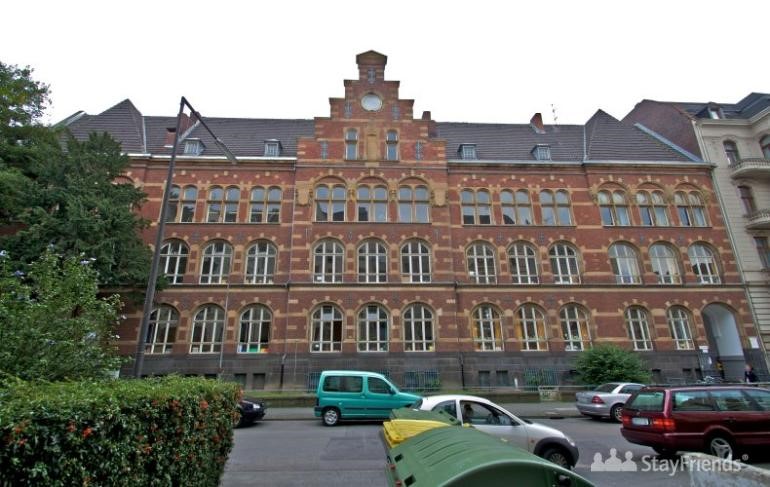
Almost unbelievably, the first school I went to in Cologne still exists.
Mourning with Mary
Ernst Eul was probably in his early thirties, but his demeanor, dark brown suits, and baldness made him look—to me, at least—much older. I did not know that was unusual; later, we all spent hours trying to guess what a certain teacher’s first name was, because they usually never disclosed it. Maybe Eul introduced himself with his full name because his last name was so short.
Eul taught us how to write, how to read (or pretend to read what we had memorized), and how to perform simple manipulations with numbers. Twice a week he made us run around the schoolyard. The structured environment and being made to learn things appealed to me; I did reasonably well except for the running around, of course. Day after day, from 8 a.m. until noon and sometimes until 1 p.m., there was Eul. He was sometimes angry with pupils who were absent-minded or loud, but he mostly seemed uncomfortable, as if he could not breathe well.
With one exception: religion. At that time, everybody I knew was Catholic and went to church on Sundays. At home, we prayed before and at the end of meals, and I also prayed before I went to bed. Our school was public, part of the city’s school district, but it was a Catholic school. There were Lutheran schools as well, and, later, I spent some time at a school where a white line across the schoolyard separated Catholics and Lutherans.
Eul lived and breathed a certain aspect of Catholic religion: The agonies of Mary, mother of Jesus, when her son was arrested, whipped, nailed to the cross, pierced with a spear, taken down, and laid in a tomb donated by a disciple. Sure, he talked about the manger and the shepherds and Jesus’ miracles and the Sermon on the Mount, but he always got back to Mary and how she suffered along with her son. Nothing could withstand Mary’s miseries. From something as joyful as the miracle of the loaves and fishes, he would be back in Jerusalem on the day of the crucifixion, within a handful of words. He was so skilled at manipulating our emotions that most of us were in tears when he went on about Mary. He usually closed out the school day this way, which meant most of us were sad and sniffling when we left. He covered the same territory from many different angles. He explained how betrayed and disappointed Mary, too, felt when Peter denied knowing Jesus. Or, he would make up a story about Pontius Pilate and how she prayed for him. As the school year went on and we became used to his Mary stories, he kept returning to her standing under the cross, watching her son die. When every other element of the narrative was sucked dry, this still had the power to make at least a few boys cry. I was not among them. I quickly tired of Mary and was glad when Eul was no longer our teacher in second grade.
A grouchy drunk
When I was in third grade, we moved and I went to a different school. One of the teachers there was an older man with teary eyes who kept using idioms that were not common in our area. Much of the time, we had no idea what he was telling us. My grandmother translated them for me at home. He came from the southwest of the country, not far from the Black Forest, where she had spent her childhood. This man, Knauf was his last name, was very moody. He never seemed to like anybody. When he was fed up with us, he stopped the class ten minutes early and kept us in the room, so we could think about our shortcomings. He also had a habit of disappearing during class while we were supposed to read, write, or draw something. Much later, it occurred to me that he was probably an alcoholic who had to get his drug from somewhere. Knauf was unpleasant, but harmless. One almost felt sorry for him.
Raging screamer
Far more dramatic were a few characters who taught at the Realschule I visited in grades five through nine. This type of school was meant to prepare you for specialized professional colleges, and after that it was work. My parents didn’t feel the Gymnasium or high school was right for me. They wanted me to take over the shoe store, and learning Latin and other useless knowledge was not required for that.
At the Realschule, some teachers appeared to be mad, or at least in permanent distress. I remember Mr. Palutke, a short, broad-shouldered math instructor who always dressed in blue suits, silver and gray ties, and shiny black shoes. He had wavy brown hair and a large, almost cube-shaped head. His small, grey eyes peered out of an always tanned face that we found puzzling—how did he manage to look this way? Palutke was always impatient when students did not catch on immediately; when he was impatient, he often became very angry; when he was angry, he would scream. His words were unremarkable: He told us we were stupid, useless, a waste of resources. But his delivery was extraordinary. Palutke shouted so loud that in summer, when the windows were open, you could hear him rage in a classroom at the other end of the building and two floors up or down. His face turned fiery red, his voice broke, and often he stormed out at that point, sometimes throwing a book or a ruler or a box of chalk against the wall. We were all afraid of him, but he never hit anybody. However, when he marched up and down the aisles between our two-person desks and scream at the top of his lungs, he was frightening. We didn’t learn much from him, because he was too distracting. Rumor had it that he ranked quite high in the Nazi military and spent many years as a prisoner of war.
Tossing books, eating animals
A teacher named Reuter, another short, but fat man with white, yellowing hair, always in the same rumpled-looking gray suit, also had an anger problem. He taught biology, or rather, he had us read aloud or copy from the textbook. To us, he was a comical figure, and we were bored. We talked amongst ourselves, played games, or read comics. We quickly figured out how we could set him off to prompt one of his displays. He did not scream, but he waddled through the classroom, grabbed books and pencils and fountain pens and whatever he could find on our desks, and tossed them around the room. Sometimes, he threw books and stationery out of the windows, and we picked them up in the schoolyard afterwards. “Be quiet, just all be quiet,” he sometimes moaned, but often he did not speak at all. He just threw things.
After one of these episodes, Reuter would become quite friendly, giggle to himself, and tell anecdotes from when he was a prisoner of war in the Soviet Union. The equivalent of his suffering Mary was a train ride through Poland and Ukraine that he described dozens of times. The prisoners were extremely hungry during that transport. Sometimes, that brought Reuter back to his subject, biology, as long as the creatures being discussed were edible. In that case, he would go on at great length about the joys of preparing and eating carp, boar, lobster, deer, or other animals that were mentioned in the textbook.
Bushman
I have often wondered how war-broken men like Reuter and Palutke maintained themselves in their jobs, but they were civil servants, which, at that time in Germany, meant lifelong job security unless you committed a serious crime. Also, the principal at that school was in no position to reign them in. He was close to 80, a fragile, trembling, sometimes incoherent man who for some reason had not retired and still taught math. After Palutke, he was a relief. But he had a nasty way of calling on individual students and calling them names when they did not perform well. “You are a bushman,” he would say—that was the worst insult he could muster, and our nickname for him. He never did this to me, and some of the mental calculation tricks and shortcuts he taught us I still recall. But I don’t remember his name.
Slow, drunk, distant
These were the extremes, but there were others. The English teacher who only got through five of the year’s 24 textbook lessons, morbidly going over the same matters. The arts teacher who was often so drunk that she reeked, could not stand up in front of the class, and sat at her desk napping after she told us to draw whatever we liked. The English teacher who preferred to leave her fur coat on and never looked at anybody. All of these people were clearly unhappy and did not enjoy the company of their students. Why did they teach in schools? I believe they enjoyed a highly structured environment with a level of control over other people, and they felt they had a certain skill they could rely on. They probably never were fired, and eventually retired from teaching without finding a replacement for the activity of so many years.
Later, I did go to a Gymnasium and graduated with Abitur at the end of grade 13. Fewer truly awful teachers were on the loose in the higher grades. In fact, some of them were extraordinary, resourceful people. I will write about them another time.
I finally finished, rewrote, rewrote, revised, rewrote, and published the third bjoiteria story. Intriguing Transformations of the Alien Mind is the first time my historical research into those aliens finds its way into a story. There will be more historical episodes, because there’s a lot to discover. I also still think that well-written, literary science fiction is having a moment.
Clockmaker Johannes Rinzerberg, who opens his Baden-Baden workshop in 1867, comes into contact with them and enjoys decades of visits and conversations. It didn’t happen to Dostoyevsky and other famous gamblers and society figures in Baden-Baden, but Rinzerberg was lucky. And he knew how to keep a secret. He never talked about his alien encounters, but left several volumes of journals full of rapturous descriptions and recollections of exalted states. His grandson Paul Rinzerberg tracks the journeys of the bjoite to Santa Barbara, California. Paul, also a clockmaker, settles there shortly before the 1925 earthquake. As his grandfather already learned, bjoite shuttles often touch down in the Santa Ynez Mountains behind the city. The local Chumash Indians have oral traditions about them that go thousands of years into the past. Paul is particularly curious about an incident in 1251, when a bjoite shuttle crashed into the Pacific Ocean and all travelers died. When he finally makes contact with the aliens, his bjoite mentor directs his explorations of Chumash art and helps him understand how the bjoite experience death and life. Paul is not given to raptures, but finds himself changing through his risky explorations. With the help of the bjoite and a woman he loves, Paul overcomes barriers imposed by his deafness and muteness, meets his future wife, and finds himself connected to a far larger world, full of miraculous awareness and bewildering, vibrant life.
Intriguing Transformations of the Alien Mind finally opens the curtain on the aliens’ inner world and sense of reality at least a little. If you have not read the earlier bjoite stories, this is as good a place as any to start learning about our guests.
Transformations costs $1.99 plus tax. Speaking of, I just paid my annual and quarterly income tax, so I need the money. I’m sure you’ll understand.
You can buy and download the story from two resources:
Thanks to each of you who read and reviewed any of the stories. You are the best! Because of you, I can believe that my continuing research is worth the effort. I hope you enjoy this episode; your feedback and questions are welcome.
After a lifetime ‘abroad’ and unable to speak any language with a proper native accent, I’m still learning how to be a foreigner gracefully. Maybe I’m simply more immature and rootless than many other people. It still bothers me when I’m in a certain country where English is not the main currency, and people assume I’m no good at speaking their language and insist on talking to me in English no matter how many times I respond in their own.
It also still bugs me when people ask me, “Where are you from?” This is often expressed as, “I hear some kind of an accent, but can’t quite place it… where are you from?” Usually, when I’m at home in Seattle and dealing with clients or professional associates, I respond as politely as I can, but don’t really know what to say.
I’ve noticed similar reactions in other long-term foreigners. It seems natural that everybody is from somewhere. But, really, where are you from? Why is it so hard to just answer the question? To start with, the assumption is that you are not from here, and an unwelcome exclusion may be implied. People put you in a box, take you out of another one, and so forth. It can be confrontational and create distance where no distance is wanted.
Also, the facts are not all that easy. I was born in Germany, never felt at home there, and left as soon as I was able to. I resided in a certain country, then lived and traveled in a couple of other ones, and eventually found my way to Seattle, where I mostly liked it and also realized I was tired of roaming. I’m still here. There really isn’t an easy answer for me to “Where are you from?” Yes, at some point I came from somewhere, Cologne, which I recall as a lovely city that didn’t really belong in that strange and cruel country, but the Cologne I remember doesn’t really exist anymore. I yearn for it sometimes, but that doesn’t bring it back. To respond with “Seattle” doesn’t seem quite truthful, especially when I’m having one of those days where I’d rather be anywhere than here. It gets complicated very quickly. I must have responded hundreds of times to the follow-up question, “But your name doesn’t sound German…?” Even though listeners’ eyes usually glaze over when I do.
Other foreigners tell similar stories. You live and travel a bit, and a few decades later you realize you’re not coming from or going to anyplace in particular, you don’t feel a lot of loyalty to any place or country, you’re from Earth and hope to be a decent person. Try giving that as an answer to “Where are you from?” and prepare for some severe irritation.
But there’s another way to listen and reply to the question “Where are you from?” My advice is to minimize any chat about the facts, because, shockingly, nobody actually cares. The questioner has noticed a difference, or something you nonetheless seem to share with her. What she is likely asking is, “What do you and I really have in common?” Now, that is something you can explore with her in a much more interesting conversation than anything to do with distant, mythical places. You can get the trivial details out of the way and move on to a more meaningful exchange. Once or twice I succeeded with something like, “I’m originally from Germany… and I really love baking bread and making pasta at home.” This approach tends to be more satisfying and truthful—bread and pasta are much closer to me than Germany ever was or will be. Most people like eating one or the other, so the risk of starting a completely inappropriate conversation is low. But you should adjust for context. In a professional environment you might want to direct the talk more towards the skills or issues you want to focus on. “I grew up in France, where people celebrate the twentieth year of SMS communications this month.”
So, fellow foreigners: Please experiment, and be patient with your conversation partners and yourselves.
And you, dear natives: I’m curious—where are you from, really?






 storiestravelsvisions