Category Archives: business

Three flavors of Nutella marketing

Do you like Nutella? I admit I do. I know it’s not exactly a health food. Nutella used to be a luxury item in our house, but by now I buy a new plastic container whenever we run out. Many years ago, Nutella came in glass jars and became dry and brittle if you didn’t eat it soon. And, if you can imagine that, it was even harder to wash off spreading knives than it is today. First brought to market in 1964, Nutella once was an artisanal, not an industrial, product. The original recipe was based on a dessert in North Italian “cucina povera,” the cooking of the poorer people.

On a slow day, I found it interesting to take a look at the Italian, French, and U.S. Nutella sites and informally compare them. Considering that Nutella is a simple breakfast spread, I found an astounding amount of messages and content to review. You may think people eating Nutella the world around are all about the same—they like the flavor, the smell, the sensation of spreading the product on warm toast, and how nice it feels if you don’t eat too much of it. But the marketers clearly don’t think so. A lot of this may seem trivial, but a lot of thinking and discussion clearly went into it.

The U.S. site presents a large, static picture of a woman and three children.
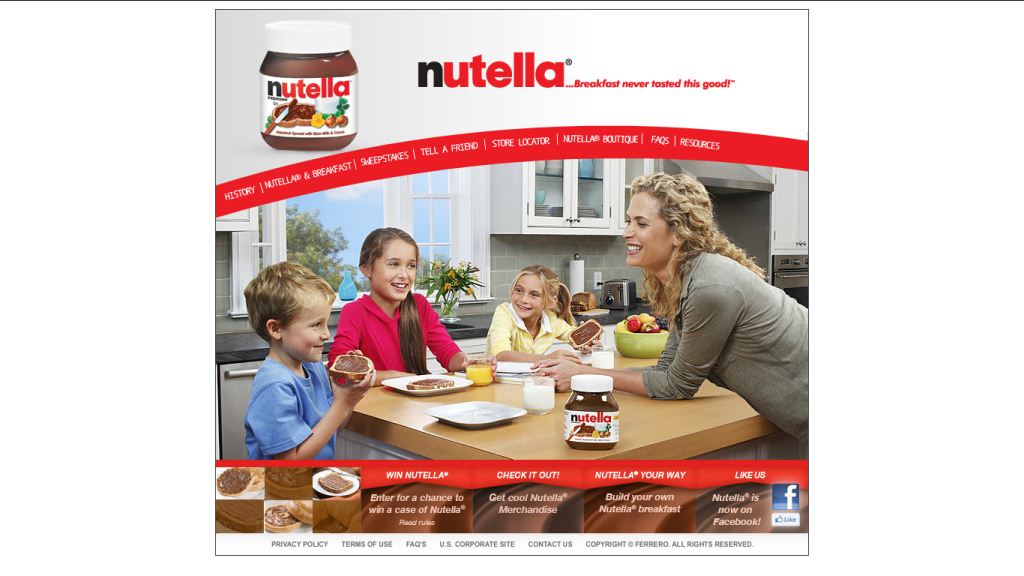
Nutella USA

They are all smiling. Each of the children has an untouched slice of white bread with Nutella, smeared with great regularity, no closer to the edge of the bread than about an inch. Links above and clickable graphics below take you to content about the product’s history, sweepstakes, merchandise, and Facebook page.

The Italian and German pages are much more fragmented—they look like European tabloids. They also have rotating content highlights at the top level of the site. Currently, the European soccer championship games are still going on. The German site offers Nutella-filled glasses with pictures of the national team’s players. In typical German fashion (I remember), there’s not a square millimeter left Nutella-free on the surface of the half bun that illustrates what you’re supposed to do with the product. Cookbooks are very popular in Germany, and so is authoritative research. The site lets you purchase a Nutella cookbook, read Nutella-sponsored research about German breakfast habits, and buy fine German cutlery from marketing partner WMF.

Nutella Deutschland

The Italian site plays you a video with opera-like, Nutella-praising vocals on the soundtrack. I’ve seen many times that Italian marketing has fun playing with opera-related clichés. The people depicted here are healthy-looking, youthful adults. No families with children, which you see on the U.S. and German sites. Italian Nutella wants to be cool and sexy, whereas U.S. and German Nutella aims for a happy family around the breakfast table. And, as you probably know, many contemporary Italians are reluctant to have children. With all the different graphical elements, I find the Italian Nutella homepage a bit too busy (but I’m from Germany, of course) and didn’t want to stay long, but it’s very typical for Italian consumer marketing.
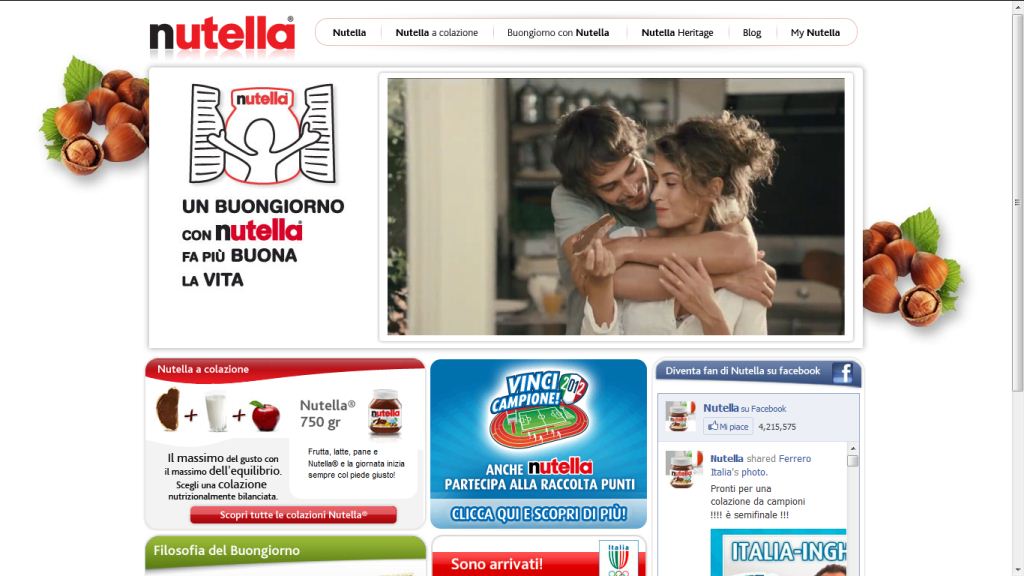
Nutella Italia

As one might expect, the Italian Nutella site features the product’s history very prominently. You can review several sections with historical content and download a PDF if you’re really into it. The voice of the copy here is full of pride. If you are really serious about Nutella, read the surprisingly loquacious blog. The writing uses a personable, occasionally authoritative style, especially when it addresses parents who are to give their children a good, Nutella-enhanced breakfast. I did enjoy the entry about edible utensils—cups, spoons, and stirrers that slowly dissolve or can be nibbled. Probably not the best things to put into your body, but remember where we found this content. There’s also an entry about an iPad app that lets you keep your coffee warm by setting the cup on the device. Is that really a good idea?

The German site has a list of FAQs, but very little additional content outside of special and co-marketing offers. The U.S. site offers more material, including a page about Nutella and Family. The content is partly derivative of an entry on the Italian Nutella blog, but the tone is a little less formal and it’s more unabashedly a marketing statement. Do the Nutella marketers think of Americans as family types that can tolerate marketing messages and glean interesting content from them better than a lot of other people? The history section of the U.S. site is very brief, but it does show you a picture of Pietro Ferrero, who started it all. Somebody must also have thought that the American viewers like illustrations, but don’t want to see too much in the way of words and detail.

The treatment of social media is interesting, too, and maybe it echoes the maturity of Facebook acceptance. In many ways and over and over, the Italian site suggests you join and like Nutella on Facebook. The U.S. site is quite restrained about that—one hint in the southeast corner of the pages is enough. And the German site? It’s even more matter-of-fact than that, with a small-scale invitation at the bottom left.

I could go on, but won’t. But now I wonder if Nutella tastes different in Italy, Germany, and the U.S. There’s one way to find out.

4 Comments

Filed under business, communications, consumer marketing, marketing

How to hire a good editor and avoid the psychopaths in the business

Good for you. You want to keep the quality of your communications and marketing materials high by bringing an editor on. Times are tough. Many editors don’t have work. It should be easy to get a few folks in to interview.

But how do you find a good candidate? You want somebody who quickly learns your business, works well with your people, and makes your materials better, day after day. Is that too much to ask?

Sometimes it would appear so. Many editors will take a bit of time to find out what you’re about, won’t get along well with your other employees, and will make changes in your documents without improving the quality or consistency.

The editing role can bring out the worst in certain people. Some years ago, I worked with an editor who, starting with day two on the job, instructed writers to take certain approaches in their drafts and, at the next draft stage, demanded changes to be made just so. As writers immediately noticed, this editor didn’t really get what the technologies and supporting marketing pieces were meant to help people accomplish and understand. The editor’s approach was abrupt, evidencing a complete lack of social skills. Writers soon found a way to work around this person. Mercifully, after a few weeks managers made a change to restore editorial sanity and returned a previous contractor who knew the technologies well and had friendly relationships with writers.

Your editor candidates don’t need to be saints. But they should be able to demonstrate competence and collegiality.

Elsewhere, I’ve watched editors have highly emotional exchanges regarding their arbitrary preferences for capitalizing or hyphenating certain words. Editors have told me they make changes in my copy because of “pet peeves” or because they have an “aversion” to a certain expression. Maybe tempted by what they think of as power in their positions, some editors seem thrilled when they have a chance to lay down the law. Even James Kilpatrick, who enjoyed huge audiences as an ultra-conservative columnist and one-time racist, felt it was necessary to playfully assemble an imaginary law court to decide the language issues he also wrote about.

You don’t want any of this. Hiring editorial psychopaths can disrupt your marketing team, ruin the quality of your communications, and cost a lot of money. You want your editor to make copy changes because they improve the quality of the language—nothing else.

Do this. When you are serious about a potential editor, ask this person to spend a little time in your office to edit a page or two of draft content (and consider paying them for their time and trouble). Next, have the candidate take a few minutes to talk you through the revisions. If you hear about likes and dislikes or other personal choices, or if the editor gets testy, thank the candidate and move on. Your new editor needs to be able to justify every single change and explain how it improves the copy by strengthening its voice, making it easier to read, aligning it with your style guide, making it grammatically correct, and getting the target audience to enjoy it. What’s more, if you can receive these comments in a professional, even-handed manner, it’s likely that your candidate will also be able to communicate and work well with your writers and subject matter experts.

Of course, you will also do your due diligence and verify that your new editor is familiar with style sheets and contemporary tools of the trade. Do not take this for granted. A surprising number of hopeful editors avoid new editing software tools and will prefer to work as they always have. Reference checks will help in this area, although they won’t turn anything up if a candidate you consider has acted imperially or manifested other editorial pathologies in an earlier position. That’s why you need to have the test first and the talk afterwards.

2 Comments

Filed under business, communications, editing

Sweet Tibetan Tea

I was thirsty and found myself at a PCC in Seattle. I wanted something to drink that was neither plain water nor some sugary juice. I saw a row of cans of Tibetan Tea and tried it. I dare you to match the copy on the side of the can for sheer over-the-top nerve and pretentiousness. If you do, I’ll buy you a cup of real tea. This what it says, missing article and all: “Our mission is to reveal raw truth of the world’s invisible. Every sip gives voice to the unheard.”

The invisible what, you wonder. Give it some thought and maybe it will come to you.

An empty can of Tibetan Tea

The can’s content provided me with 200 calories I didn’t need. It was extremely sweet; the second ingredient on a list that includes “natural flavors” is sucrose. Another is “tea”, but it’s not made clear what kind. I’m not sure how “Tibetan” this drink is. Probably about as much as bottled Italian salad dressing is Italian. The mention of Tibet here means to garner sympathy and, thereby, foster sales. Not that that’s bad, but it might seem jarring to people who associate certain values with the country. Intrigued by a detail I noticed in the manufacturer’s address, I strolled to the Tibetan Tea site when I was back in my office. Disappointingly, there weren’t any more dramatic marketing statements, just a couple of modern-orientalist touches in the copy.

But listen. There is another story here, too. I had met Penny Stafford, the owner, before. She used to have a fine, small coffee shop in Bellevue called I Belvi, which was supposed to be the Italian for “The Wild Animals” (and unfortunately included a grammatical error). She made excellent espresso that I drank many times. Penny always had a friendly word for her guests, and enjoyed sharing about the animal rescue efforts she was active in. Starbucks, which has several locations not far away, did its best to ruin her. Starbucks representatives even handed out samples of Starbucks coffee in front of her business. This was outrageous enough to come to the attention of the local media. The Seattle Post-Intelligencer, still a going concern at the time, published an article about Penny and her determination to survive.

Eventually, I Belvi closed. But it wasn’t Starbucks that did it in. Construction projects across the street brought lot of workers to the coffee shop. Some of them treated the place like an extension of the job site, visiting in noisy groups, talking loudly on their mobile phones and Motorola intercom devices, leering at Penny, and making the place unpleasant for the rest of us. I quit going there and probably some other people did, too. At some point, I noticed the new buildings were done and the coffee shop no longer there. That made me feel bad. Maybe I’m wrong, and Penny closed because she was ready to do something else, not because nobody came for coffee anymore. In any case, I’m glad she’s on to another venture, sweet as it is. And, I appreciate that she’s apparently still involved in helping animals in need.

Leave a comment

Filed under business, communications, marketing

Hello, there. Nice to see you here!

Thanks for stopping by! My name is Chris Lemoine. I live in Seattle, Washington, United States. I’m a writer and traveler who usually earns his living as a marketing writer, content strategist, and account manager. In this blog, I will share ideas and experiences related to writing, content development, communications, languages, and travels. If you want to see pictures from trips, visit Imagerie Lemoine. You can also find my profile on LinkedIn. Feel free to connect or send mail, especially if you’re thinking about sending me work. I’ll be happy to discuss projects anytime.

Leave a comment

Filed under business, communications, personal, writing