Saints, heroes, villains (5): Angry always, forgotten quickly

The first thing you noticed about Josef Peuster was that his shiny head was tiny for how tall he was, and he looked to be at least seventy-five. Peuster ran a duplication machine at Bayer Leverkusen, where I worked for a few months after returning from my first trip to Paris. (See previous installment in this series.) My job was to learn how the machine and related processes worked so I could fill in for Peuster when he went on four or five weeks of vacation.

To get to work, I had to get up at about 4am and catch a tram and a bus and another bus to Leverkusen, one of the most polluted, unhealthiest environments in the world. Sometimes, when I went to lunch or ran an errand to a distant building, I took a company bicycle and rode through spectacularly human-hostile areas, where yellow and black, foul-smelling steam spewed from gigantic pipes and made it hard to see and breathe.

Peuster, the duplication machine, and I were in an office with six engineers who were part of the equipment maintenance organization. This work environment was all-male, all-white. Work orders would come in large cardboard folders, often with architectural drawings attached, for some sort of planning. Peuster and I would get copies of the documents and duplicate certain forms that were routed around other departments for signatures and approvals, material requisitions, or other bureaucratic routines. The work was simple—we didn’t even have to think about which forms went with which work order. Check marks on a yellow sheet told us all we needed to know. We picked the right forms, ran them through the duplication machine to copy certain basic information onto them, crammed them into their folder, and put all the folders to rest in our outbox, where a messenger retrieved them.

Peuster’s mission in life was to slow the process down and make work as miserable as possible for everybody. He let folders sit instead of processing requests, telling people inquiring about the slowed flow they were tyrants and slave drivers. On Monday mornings especially, but also at other times, he would insult anybody who came across him. “You need lots of paper because you put out so much shit,” he’d say. Or, “That’s too much paperwork to cover up the fact that you don’t have balls.” And so on. When he felt friendly, he said, “What is this crap, you don’t really need this, do you?” When somebody got impatient or irritated, he would say, “What’s the matter with you… she didn’t let you do it?” He went on long breaks, during which I would catch up. He told me why he hated people—somebody had made a joke at his expense ten years ago, somebody else always seemed to look at him in an unfriendly manner, another colleague was a socialist and active in the union, and so forth. Peuster didn’t like anybody. He tolerated me because his job needed to be done while he was gone. He didn’t mind when, after a couple of days of training, I just did the work and let him sit around for a few weeks until his vacation started. Somebody must have listened to Peuster describe how complicated and demanding the job was, because that lengthy training was not at all necessary. Or maybe they just heeded his request so he wouldn’t be even more of a pain to be around.

He always talked while I worked. Peuster was in his late fifties, but already had severe health problems that he complained about. Once I was familiar with his repertoire, the conversation was entirely predictable. Without any need for me to chime in, he simply spouted all day. “The damn doctor told me to quit smoking,” he said. “That idiot doesn’t know anything, he’s too young. He doesn’t understand what it’s like when your wife won’t let you sleep in the same room because she misses it and you can’t do it. I often have a hard-on in the morning, but it’s just because I have to piss. It’s nothing that works. The damn drugs don’t help, either. I get exhausted when I go upstairs to the bathroom. Damn these glasses, I can’t see anything in this crossword puzzle. Look at those idiots, do they think we’re machines? They’re just stacking up those folders like they expect us to stay until midnight. The hell with it. I’m too sick to work so hard. Another couple of years and I can retire, if I live that long. Look, there’s the chief engineer, pretend you’re busy, or he’ll be on my case, that damn jerk. Sheesh, what a stupid face he has, like a sheep…”

And so on, eight long hours every day. Eventually, Peuster went on vacation. While he was out, I managed to do the work in about four hours every day and spent the rest of the time reading and smoking. I still had to be there for eight hours, because somebody could need forms to be duplicated any time.

When Peuster returned to work, he was worse than before. His face was always red, probably because he was so angry. He would curse people and everything else. He had lost weight and looked unhealthily thin. He fixated on the chief engineer, a much younger man who never got upset with Peuster’s antics. Complaining about this man took up much of Peuster’s day.

The chief engineer’s last name sounded almost like the German word for “cripple.” One afternoon, when the chief engineer’s office was empty, Peuster shouted across the area, “Time to stop pretending you’re doing anything, boys. The damn cripple is gone.”

Except he wasn’t. The chief engineer was behind his desk, looking for something on the lowest rung of a bookshelf. He glanced our way and did not say anything.

Peuster was back at work the day after, but then he was gone. Somebody had persuaded him to take retirement early. Peuster had spent almost twenty years plaguing his colleagues, but his memory and shadow did not linger. Nobody ever mentioned him. I worked for another week or two, and then my time was up and I started taking courses at the university.

Leave a comment

Filed under business, heroes, personal, saints, saints heroes villains, villains

Saints, heroes, villains (4): Serenity with a secret

When I graduated from my school in Germany at the end of the 13th grade, I took some time off before I started a temp job at Bayer, the pharmaceutics manufacturer that ruined people’s health and the environment all over the area. (More on a villain there some other time.) Before I went to work, I spent two months in Paris. I didn’t have much money, so I stayed in a youth hostel just outside of the city limits and took buses and the metro to get around.

That youth hostel wasn’t your typical wholesome hiker, biker, live-simply-folks, and naturalist hangout. Far from it. It was more like a rock’n’roll stoner commune where the faint line between men’s and women’s quarters had long vanished. Some people arrived, took in the social scene for a few weeks, and never saw the Eiffel Tower or much of anything else. A couple of the scintillating, resourceful travelers I met there later visited me in Cologne.

However, I never saw Rasoul again. He was there before I came and left in the middle of the night, a couple of days before I took the train home. Rasoul was from Algeria, but I don’t know how long he had been away from there. He did not travel for fun the way the rest of us did, I’m sure of that. Maybe he was waiting for somebody or something. He was older than everybody else there and looked a little like Gabriel García Marquez in his early forties. Unlike Marquez, Rasoul did not write fiction. He wrote poems.

Rasoul’s poetry rhymed and sounded marvelous when he read it to us, his voice so low we guessed more than we heard the words. His poems were never longer than sixteen lines or so. His handwriting was ornamental, almost calligraphic. Sitting next to him, I could not read it. I don’t remember what the poems were about—a deity, an angel, a relationship, a forgotten magic. It was lovely to listen to him.

Rasoul also told stories about his travels and experiences. My French at the time wasn’t so great, and I did not understand all of it. But I enjoyed listening to him, watching his lively facial expressions, and catching the gist of an anecdote. I missed his company when he wasn’t around. He was very popular with the women in the place and spent more time with them than with his male friends. Sometimes he disappeared for a day or two, but always returned, until he didn’t.

One of Rasoul’s specialties was interpreting a person’s handwriting. He looked at the letters and gave way to his creativity and intuition. From time to time, I received a postcard from a friend at home. One was from a girlfriend who I was about to separate from. Rasoul’s interpretation of her character was a complete surprise and, I thought, very true. It almost made me feel in love with her again. But she and I were wrong for each other. I knew that.

At the time, I often wondered where Rasoul had come from and where he was headed. He just didn’t seem like an ordinary person, or at least he wasn’t like anybody I had met up to that point in my life. Nobody else had his serenity and poise. Back then, and remembering him now, I believe that something had happened to him—a tremendous insight, a transformation. I don’t know what the visible form of this event was or why it affected Rasoul the way it did. I wonder where life took him after he left the youth hostel, but I’ll never know.

Leave a comment

Filed under heroes, personal, saints, saints heroes villains, travel

Saints, heroes, villains (3): Caretaker of her colleagues

When I took a sales job that was to end disastrously, in a company that was about to go under, with a boss who was about to relocate and be replaced by somebody I did not get along with, surrounded by very conservative colleagues with military backgrounds and attitudes—in that worst-fit environment, Alice was the office manager and executive assistant who took care of people. I’m not using her real name for the sake of privacy.

When I first made contact with the company, Alice arranged my interview with the general manager, who was going to be my first boss. She sounded extremely polished and professional, which raised my expectations about the organization; unfortunately, she was in a class by herself and nobody else matched her poise and style. When I was about to be fired nine months later, Alice showed me the warning letter that my second and last boss had her draft. She was upset that he would make her do this instead of writing it himself. She also disagreed with the content of the letter, which made me feel better about it, because Alice was the one person there whose judgment I respected. Because of her indiscretion, I was able to prepare the conversation, and came away less upset and with much better terms.

Alice’s windowless office was next to that of the general manager. Both men in that position were moody, often angry characters, about the same age and with roughly the same amount of years working behind and ahead of them as Alice. One of them was loud and yelled at people, the other one preferred to speak quietly and glare with eyes of poison. Both of them were in the habit of shouting for Alice from behind their desk when they needed something—a document from the archives, a reminder of a commitment or meeting, a meeting to be set up, and so forth. When this happened while one was in a meeting with the boss, it could be most unpleasant to sit there and watch Alice being treated shabbily. Somehow, she never let that darken the friendly relationships she had with the rest of us. At the same time, she did not invite gossip about the two bosses or anyone else. But she helped everybody else work with and around the two difficult general managers. Everybody knew to call Alice first if they had a meeting scheduled or had to approach the boss about something. She would advise us whether it was a good time, or whether one should reschedule or wait.

Another woman working in the office once suffered a devastating epileptic attack and was not able to drive to work for several months. Public transport from her suburb was unreliable and would have taken a couple of hours each way. Alice, who did not live anywhere close to this colleague, picked her up every morning to take her to work. At the end of the day, she drove her home. She continued doing this without a break until the woman was able to resume driving. From time to time, I heard about similar kind acts Alice performed, but she never volunteered any information about them.

Alice loved animals, especially cats, and her husband would not let her have any. Sometimes she bought toys and treats for other people’s cats and dogs, or donated them to a shelter. She never forgot to ask about her colleagues’ companion animals, whose names she always remembered. “I can’t have my own animals, so I have cats-in-law and dogs-in-law,” she said. When I went to Rome and took pictures of the many, often well cared for stray cats there, I put a little album together and told her about the Roman cats and the cat sanctuary at Torre Argentina. It made her happy to hear about it.

For a couple of years, Alice and I sent each other Christmas cards and updates, and eventually I lost touch and a mail was returned to me. If she is still alive, without a doubt she is making life easier and more graceful for the people around her.

Leave a comment

Filed under heroes, personal, saints, saints heroes villains, villains

Saints, heroes, villains (2): Charmer, liar, thief, abuser

I got to know Robbi—as everybody called him—through friends of a friend in the same scene of musicians, artists, and aspiring bohemians, back in the Cologne of the 1970s. The last I heard of him, around 1979, was that he fell, or maybe jumped, through a glass door while drunk.

When I first met Robbi, who had probably tagged along with other people who were visiting me in my apartment, I thought he was funny, insightful, and interesting. We jammed together. I played a violin, holding the instrument Indian-style, and Robbi had his bongos with him. That was fun and exhilarating music-making. He had style, dressing in a colorful, silky Hippie elegance.

A friend warned me. He said that Robbi often stole from people, told stories that weren’t true, and had some other unpleasant habits. Apparently, he had taught himself to play percussion instruments and had come close to joining bands, but not more than that.

Nothing special, I thought. In those days, I knew colorful, incredible characters who were never what they seemed and had forgotten the truth about themselves if they ever knew it. But Robbi’s charm, talent, mendaciousness, thievery, and violence beat everybody else by many miles.

For several months, he and I were friends and companions, as best as we knew at the time. He seemed uneducated—he had probably never read a book—but very smart in his assessment of people. He understood music and was a talented drummer. Before encounter groups and my other adventures in therapy, he found ways to reveal me to myself without shaming me, and I was very grateful to him for that.

He also stole my rent money once, and my cigarettes, drugs, books, and record albums, repeatedly. Somehow, he was so charming, and I so naive, that I let this go every time. He also lied with compulsive, tireless creativity, and because he did so much of that and was unable to remember and reconcile his conflicting tales, he was often found out and confronted, which made him very angry. Very soon, I realized that his stories of playing with well-known local bands were never true. Women he called his lovers denied having spent time with him. Robbi told the typical lies people will tell to look more accomplished and desirable than they really are. He also lied for no apparent reason, for example, when he spun a story about some boring party at somebody’s house when he and I had been elsewhere during that time.

When I compared notes with other people who knew him, it turned out that he went by several names and did not have a place to live. I didn’t drink alcohol and did not go to the popular boozy hang-outs, so I only heard second-hand about his drinking—all paid for by others—and his fights when he became drunk and aggressive. Just like me, nobody had ever seen him eat or sleep. Some people had watched him shoot heroin, but supposedly he was not an addict.

Eventually, it became difficult to have a conversation with Robbi, because you could not believe a single word. Then, when a friend needed a new place to live, he conned him into moving to a flat that actually belonged to somebody else; the owner did not find out until the person had moved in with all of his stuff. While the unfortunate tenant looked for another space, Robbi stole and sold his stereo and other possessions. Shortly after that, he visited me together with a woman he introduced as his girlfriend. I still remember the dark, painful tension of that afternoon. She was afraid of him. He slapped her in the face when she looked at him in a way he did not like. I made him leave the apartment. Instead of calling a friend to pick her up or accepting my offer to take her somewhere, she went with him. I never saw him again after that.

I never understood why Robbi had to lie so much. With his talent he could have made his stories become true, earning a living as a musician. With his charm and sense of humor, he could have won people over without abusing their confidence. I did not know much about him, and neither did anybody else. I can imagine what brought him to act the way he did, just like I can imagine his life in the years after I distanced myself from him.

In a large cemetery in the south of Cologne, many hundreds of soldiers’ graves form endless lines of small, white crosses. They are in different sections—I forget whether they are grouped by war or by country—separated by low walls. At an opening in such a wall, two small, chapel-like buildings offer shelter from grief, rain, and sun. One sunny morning, Robbi and I ended up here, sitting in one of these stone huts, enjoying the gorgeous light on the beige and yellow walls. We improvised some music on violin and bongos, and were very happy. I treasure that moment.

Leave a comment

Filed under mind, personal, saints heroes villains, villains

Saints, heroes, villains (1): The cab driver who got me not to be myself

When I was a boy, I had a fat, heavy book called Helden und Heilige, which translates as “Heroes and Saints.” It was a work of hagiography, with life stories, appreciations, and images of all the saints of the Catholic church. I loved reading about these people. The more remote they were in time, the more interesting feats and miracles they were said to have accomplished. I was very disappointed when the church eventually reformed its calendar and a few of my favorite saints did not have a name day anymore. Today, traveling in Europe, I sometimes come across churches, memorials, ruins, rocks, and features of the landscape named after fascinating, amazing saints and heroes who may have lived there at some point. At least somebody’s story became associated with a place that helps to keep a memory or myth alive. Quite a few of these saints appear to be known only in the regions close by.

We all meet remarkable people in our lives. You don’t have to be G. I. Gurdjieff to have this happen to you. We also cross paths with deceptive, troubled, and vicious characters. I know I have benefited from getting to know both kinds. They don’t ever deserve to be forgotten, even if I never knew who they were or what happened to them after we parted. Starting today, I’ll be presenting some of the saints, heroes, and villains I’ve had the fortune to meet. Today:

The kind cab driver who took me to my house and back to the airport

A couple of years ago, Evelyn and I went to Ravenna, Italy, for the first time. Our flights went from Seattle to Amsterdam and from there to Bologna, where we would pick up the rental car. The long Amsterdam flight left around 1:30pm and we got to the airport shortly after 11am.

We checked our luggage, got our boarding passes, and got into the security line.

That’s when I realized I didn’t have my driving license. Without the license, I wouldn’t be able to get the car in Bologna. The printed copy of it wouldn’t do me any good. Without a car, we would not be able to take day trips to the many places in the Emilia Romagna where one cannot get by train or bus. It would still be an interesting time, but probably disappointing in some ways. We decided I needed to get my license, which was somewhere in our house.

While Evelyn stayed in line for her screening, I rushed out of the airport and got into a taxi. I was beginning to panic. Time suddenly felt very short. The driver was a kindly-looking man in his sixties. He had a long, white beard and wore a turban. His voice was gentle and pleasant to listen to. I explained my query and that I hoped not to miss my plane. I forgot what he said, but, surprising myself, I was immediately at ease.

It was a beautiful, blue-sky September Saturday. Freeway traffic into Seattle was horribly backed up. By the time we had to slow down, I didn’t care anymore about making my plane. The driver and I were in conversation. I don’t remember all of what we talked about, but I do recall him telling me about his family members in India, and in Atlanta, New Jersey, and other places in the United States. “I have been to visit them all,” he said. “I am so happy I don’t live where they do. These places are not beautiful. But Seattle is. They come to visit me and are jealous. ‘Welcome to the heaven’, I say to them.”

Usually, I would be very unpleasant and awfully stressed out in this situation. But that man helped to relax, accept, and let things be. I remember thinking, “He’s right, this is one of the best places in the world. It’s not a big deal if my miss my plane and get to Ravenna a day later. Or never.” I also remember saying to myself, “This is not like me at all. It probably won’t last, but it’s very nice for now.”

Eventually, we reached our exit and got to our house. I asked him to wait in front. I ran into the house, unlocked my office, found the license on the scanner/printer, locked my office, locked the house, rushed back to the cab. The driver was gracefully turning a page in a leather-bound book with Arabic writing on the cover. He closed it immediately; I didn’t see what it was and didn’t want to quiz him.

On the way back to the airport, the driver shared more of his views. “Trust is extremely important, it’s the most important thing,” I remember him saying. “Trust and faith. I trust in God to take care.”

Eventually, he dropped me off in front of the terminal. I paid and gave him a large tip. He waved and wished me a happy journey. The plane was already boarding when I got to the gate.

I did not get the driver’s name. He was the kindest, most calming person I could have met under the circumstances. It’s unlikely I would ever share his religious convictions. But his serene graciousness, gentle humor, and kind presence? I can only hope to aspire to that.

So, “welcome to the heaven,” merry Christmas, a delightful solstice, or whatever else you celebrate.

Leave a comment

Filed under personal, saints heroes villains, travel

Where are you from?

Technically, I'm from here. But how true is that?

Technically, I’m from here. But how true is that?

After a lifetime ‘abroad’ and unable to speak any language with a proper native accent, I’m still learning how to be a foreigner gracefully. Maybe I’m simply more immature and rootless than many other people. It still bothers me when I’m in a certain country where English is not the main currency, and people assume I’m no good at speaking their language and insist on talking to me in English no matter how many times I respond in their own.

It also still bugs me when people ask me, “Where are you from?” This is often expressed as, “I hear some kind of an accent, but can’t quite place it… where are you from?” Usually, when I’m at home in Seattle and dealing with clients or professional associates, I respond as politely as I can, but don’t really know what to say.

I’ve noticed similar reactions in other long-term foreigners. It seems natural that everybody is from somewhere. But, really, where are you from? Why is it so hard to just answer the question? To start with, the assumption is that you are not from here, and an unwelcome exclusion may be implied. People put you in a box, take you out of another one, and so forth. It can be confrontational and create distance where no distance is wanted.

Also, the facts are not all that easy. I was born in Germany, never felt at home there, and left as soon as I was able to. I resided in a certain country, then lived and traveled in a couple of other ones, and eventually found my way to Seattle, where I mostly liked it and also realized I was tired of roaming. I’m still here. There really isn’t an easy answer for me to “Where are you from?” Yes, at some point I came from somewhere, Cologne, which I recall as a lovely city that didn’t really belong in that strange and cruel country, but the Cologne I remember doesn’t really exist anymore. I yearn for it sometimes, but that doesn’t bring it back. To respond with “Seattle” doesn’t seem quite truthful, especially when I’m having one of those days where I’d rather be anywhere than here. It gets complicated very quickly. I must have responded hundreds of times to the follow-up question, “But your name doesn’t sound German…?” Even though listeners’ eyes usually glaze over when I do.

Other foreigners tell similar stories. You live and travel a bit, and a few decades later you realize you’re not coming from or going to anyplace in particular, you don’t feel a lot of loyalty to any place or country, you’re from Earth and hope to be a decent person. Try giving that as an answer to “Where are you from?” and prepare for some severe irritation.

But there’s another way to listen and reply to the question “Where are you from?” My advice is to minimize any chat about the facts, because, shockingly, nobody actually cares. The questioner has noticed a difference, or something you nonetheless seem to share with her. What she is likely asking is, “What do you and I really have in common?” Now, that is something you can explore with her in a much more interesting conversation than anything to do with distant, mythical places. You can get the trivial details out of the way and move on to a more meaningful exchange. Once or twice I succeeded with something like, “I’m originally from Germany… and I really love baking bread and making pasta at home.” This approach tends to be more satisfying and truthful—bread and pasta are much closer to me than Germany ever was or will be. Most people like eating one or the other, so the risk of starting a completely inappropriate conversation is low. But you should adjust for context. In a professional environment you might want to direct the talk more towards the skills or issues you want to focus on. “I grew up in France, where people celebrate the twentieth year of SMS communications this month.”

So, fellow foreigners: Please experiment, and be patient with your conversation partners and yourselves.

And you, dear natives: I’m curious—where are you from, really?

Leave a comment

Filed under communications, mind, personal, travel, Uncategorized

Nutella defends itself in France

A while ago, I took a look at the different flavors of Nutella marketing in different countries. (Disclosure: I eat the stuff. I know it’s not good for me.) Currently, I’m spending a few weeks in Aix-en-Provence in France. Nutella is in the news and finds itself under attack from food and health writers because of its use of palm oil and its somewhat sketchy record as an actual food item. The Ferrero company, which owns the brand, took out a very expensive, two-page ad in Le Monde today (see illustration).

Ferrero, the owner of the Nutella brand, took out a two-page ad in the print issues of Le Monde from Saturday, November 17.

The sign being held on the left says, “Nutella is delicious, but why does it contain palm oil?” The ad copy talks about responsibility and choices, and states that the attacks on Nutella because of its use of palm oil are unfair. It explains why Ferrero uses palm oil—supposedly, because it allows the manufacturer to avoid hydrogenating fats and the possibly resulting trans fats. Palm oil used in Nutella, the copy says, comes from sites in Malaysia and New Guinea, and is meant to be entirely sourced from sustainable production by 2015, after which year no forest will be lost because of it.

Then the ad tells us that, “contrary to received ideas and certain opportunistic communications,” palm oil is not dangerous if eaten as part of a balanced diet. It’s better than butter, the writers mention, which isn’t saying much—many things are better for your health than butter, including (probably) most dirt. And, we can review a little table that compares the nutritional demerits of a Nutella tartlet with comparable products. Nutella comes out a little better.

The problem is that nobody eats just one little bit of Nutella and then does it again in a couple of months. Consumers, and especially their children, really like this product a whole lot. Forget it about a balanced diet. They suck it right up. While they may be factually correct, Ferrero’s statements are disingenuous—I’m sure they understand how consumers consume, just like the tobacco companies probably have a good sense of how and when smokers smoke.

Not to be all down on Nutella and Ferrero, the website they refer you to, mangerbouger.fr, educates people on some of the basics of nutrition and health with sections such as “Why move?” or “What does eating healthily mean?” Some of the recipes are very nice and sound healthy, too. The site is not affiliated with Ferrero or Nutella, but with the French Programme National Nutrition Santé, a government initiative to bring healthful thinking and practices to food and everyday life that’s been around since 2001. But, if you want more from the Nutella folks, there’s nutellaparlonsen.fr, “Let’s talk about Nutella,” which expands on the content of the ad.

Le Monde itself complements or maybe even balances the ad with a short article on page 28 of its weekend magazine (see illustration).

On the same day, Le Monde published this little Nutella-themed article in its weekend magazine. You need to know one key fact from the article to understand the costly two-page ad.

We learn that 105 millions of jars of Nutella are sold in France every year—imagine—and that “France’s youngsters have fallen into Nutella.” France is the world’s biggest market of Nutella consumers, and 75 percent of French households buy the product. The government is thinking to quadruple the tax on the use of, you guessed it, palm oil, which is not considered sustainable or healthy. Writer Jean-Michel Normand jokingly talks about a “Chocolate Party” similar to the American “Tea Party,” and notes the planned tax might be a tad high. But he also mentions that Nutella is a “caloric bomb” and that the label on the jars, somewhat mendaciously, doesn’t list “palm oil,” only “vegetable oil.” And, as he mentions, Ferrero has stated in any case that it will never change the composition of the product.

There you have it—your Nutella news from your French correspondent. If you eat it, do so responsibly, just a little bit today and nothing for the rest of the week. Of course. I knew you didn’t need reminding.

1 Comment

Filed under business, communications, marketing, sustainability

On the Summerland trail, ten years later

It took me ten years and a couple of weeks to come back here. I last walked on the Summerland trail at Mount Rainier National Park in September 2002. This was on a week day, and my Civic was the only car in the parking area when I arrived at about 8am. Roughly three miles in, one crosses a one-log bridge with a sideways-leaning railing. After walking about a quarter of a mile on the other side, I saw a small black bear on the trail, doing who knows what, thirty feet or so away from me. While I waited for him to move away, I took a picture that didn’t turn out because I was not holding the camera still. Then, much closer to me, at about half that distance, the bushes rustled and a much bigger bear emerged, looked at me, and started moving in my direction. I panicked and ran, my heart beating in my ears. My memory insists that I flew down the steep, rocky trail at cheetah-like speed until I got back to the bridge.

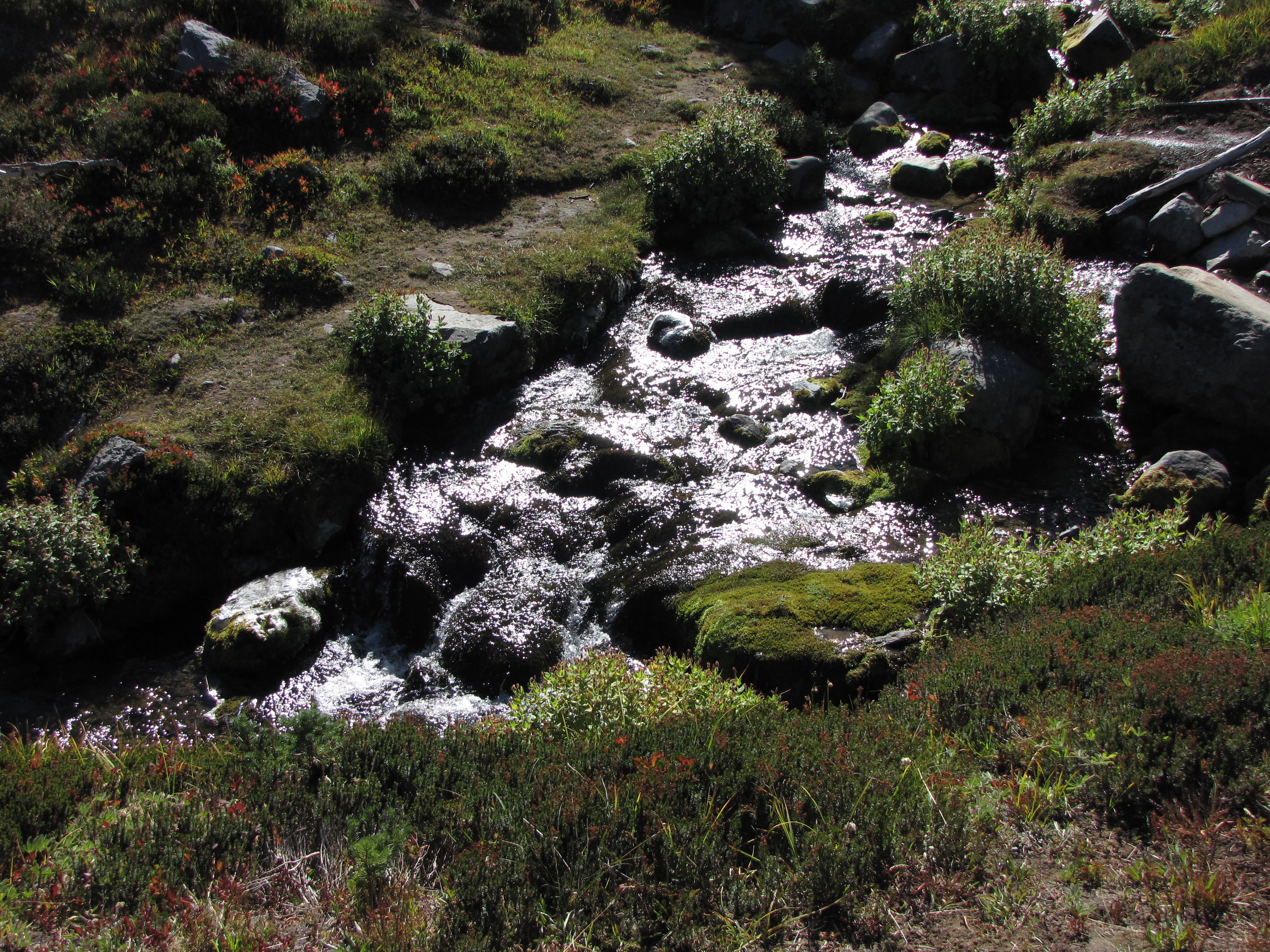
Water and ice at Summerland

Since then, I’ve not been back to the Summerland trail. It’s one of the most popular in this National Park, which millions of people visit. The crowd-free periods, after the thaws in late spring until summer takes off, and from fall until it snows again, are quite brief, and there are only so many weekends. From Seattle, it takes about two to two-and-a-half hours to get there, much of it on tedious freeways and suburban roads. But yesterday, I had a Saturday to myself and decided to go.

I got to the White River entrance on the Park’s east side in under two hours without even speeding—there wasn’t much traffic yet. I paid a $15 entrance fee, which allows me to return for seven days. Considering how breathtakingly amazing and lovely the place is, this is a good deal, even if one only visits once. When I used the restroom close to the entrance, I realized how chilly it was. I was delighted—at this point, I find Seattle’s endless warm temperatures and cloudless blue skies depressing.

After crossing Frying Pan Creek, one parks across from the trailhead, about three miles’ distance from the Park entrance. I was glad that some other people were already there and had set out before I did. Maybe the bears would understand that it was better for them and us not to meet. The trail to Summerland is about 4.2 miles one way, ascending with almost every step. Most of the gentle, first three miles take you through forest. Lots of tall evergreens, some fallen trees, small shrubs, and unusually few mushrooms, because it’s been so awfully dry the last few months. I enjoyed feeling cold until I forgot about it as I was climbing. The sun blanched the tops of the trees, but rarely came down to my level.

With less and less sun and light, these blue flowers at Summerland hang in, although many of them are already looking tired

However, as soon as you cross that bridge, the scenery changes. The trail rises more drastically. You face dramatic views of the mountain, glaciers, and outlying formations. Tall trees eventually give way to shrubs and clusters of shorter trees. Before, in the forest, smells were dry, dusty, and clean. Here, it smelled like being in a huge wine cave, sweet and pleasurably rotten. I took my time to appreciate mossy rocks, patches of frost on ground shrubs, icicles dangling off rocks, and small blue flowers.

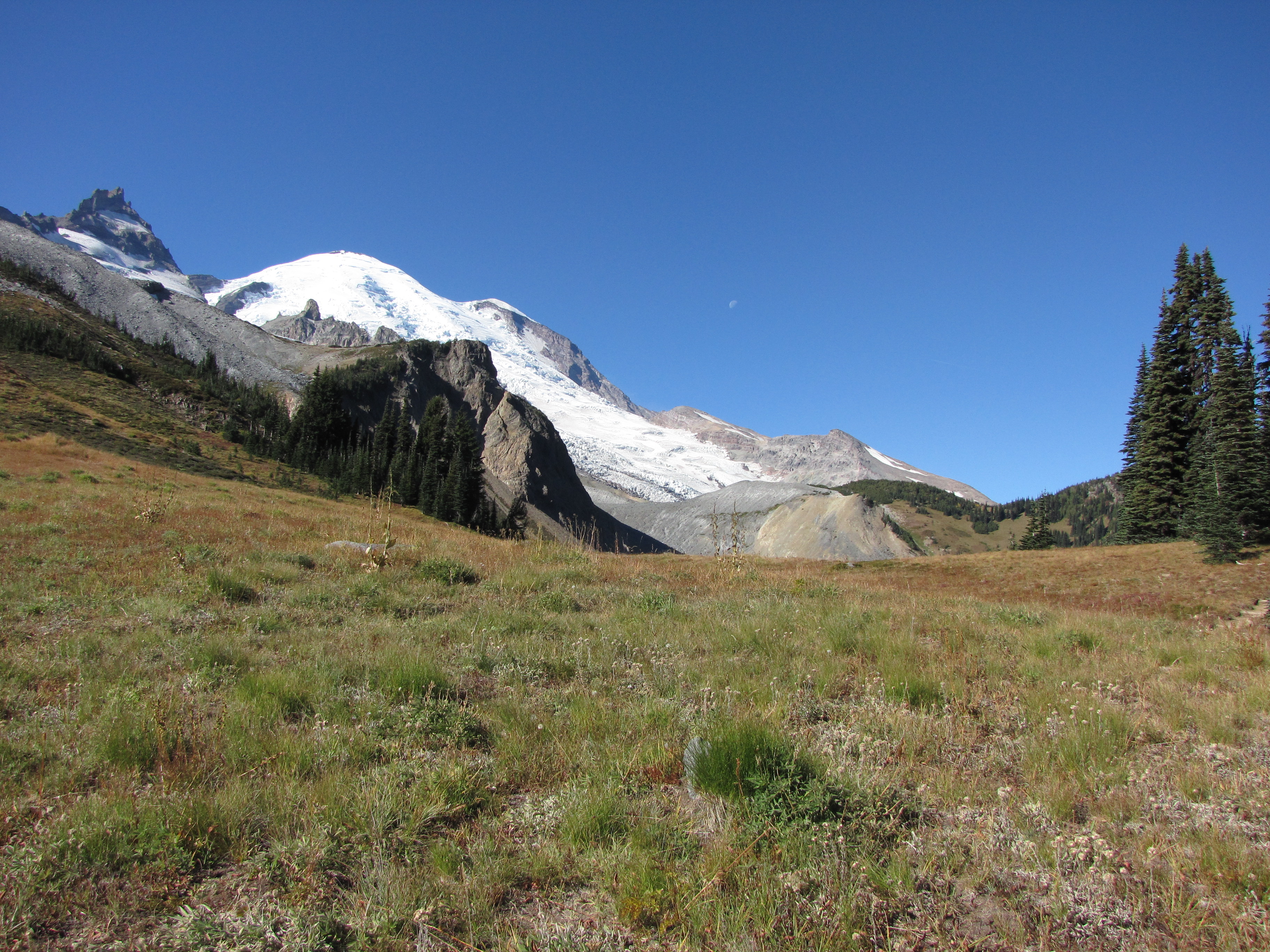
Up at Summerland

Eventually, after a hike of about two hours, I got to Summerland, a large subalpine meadow. Signs ask you to stay on the trails and not ruin the land any further, but some hikers merrily took off for their picnics right in the middle of it. But there weren’t enough of them to spoil the experience. Here, one feels close to the mountain’s strange, quiet life. Hues of blue and green on the rocks, together with the warm greens, yellows, and oranges of the vegetation, make the place look playful. The moon was still in the sky. Patches of clear ice covered rocks. Small ice formations lingered along creek beds and in other shady spots. After a break, I continued for another mile or so, until the trail got too squirrelly for me and the ice patches were too large to navigate comfortably.

Ice art by a small creek

The way down took me much longer. For one thing, I was sad to leave. Also, the trail was bone dry, with lots of treacherous, rolling rubble, and I had to pay attention, which always slows me down. My walking stick saved me from falling many times. On the return hike, I finally heard a few birds. Other than them, the only wildlife I saw was a few insects and some chipmunks. A woman explained to a group of teenage girls, “Many of the chipmunks carry the plague. You must avoid them at all costs.” But no bears. No little bear, no big bear. I was happy about that.

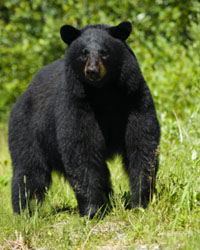
No bear this time!

I had much time to reflect on then and now. In 2002, I was 49, living off my stock options and drawing unemployment after having been laid off at Veritas Software, which was eventually bought by Symantec. In 2012, I’m doing freelance work after having been laid off at the small marketing company where I spent most of the time in between the two Summerland hikes. In 2002, I used email and regularly visited some of the same news sites I still go to today, but social media was not in the picture. Back then, I weighed a bit more. But now my knees are getting creaky and I can feel twinges of arthritis in my hands and feet. In 2002, our neighborhood was much more troubled than today, and we were going to have a home invasion in early 2003. Today, different people live across the alley; trouble still abounds but crime seems more under control. There were certain things I didn’t know in 2002—for example, that my heritage is part Jewish. Or that the wars that had just gotten started would still go on now, with no realistic end in sight, no matter what official verbiage suggests.

Today, more so than ten years ago, I wonder how much time I still have to go on walking the Earth. Will I get back to Summerland anytime soon?

2 Comments

Filed under personal, travel

Urban Hiking: A Way to Grow with the Power of Attention

In most of our cities, you find areas you don’t know much about, even if you live there. When you travel through them in your car or on public transport, you don’t pay much attention to them. They just don’t look all that interesting or attractive. Maybe they’re not entirely safe. Walking there may be unpleasant and difficult because of intense traffic, missing sidewalks, freeways and rail lines cutting off access, or a lack of intersections where pedestrians can cross safely.

At home and when we travel, we should pay more attention to these places. We surround ourselves with exquisite, complex environments and infrastructures, but we don’t always know what’s there. The people working or living in these overlooked areas don’t always like it there, either. They may be too poor or uninterested to take pride in their neighborhoods, and let properties fall down and streets be strewn with refuse. If their work takes them there, they probably know exactly how to get in and out while paying minimal attention to what they don’t want to see. As a consequence, many cities include neglected and forgotten districts with large populations.

I think the best way to learn about these areas is to walk through them. It gives you a chance to see the faces, breathe the air, see the sights, without escaping the moment. You never know what you might find. In many years of exploring cities in different countries, I have always found the forgotten districts to be worth the time, risk, and effort it takes to get to know them. Sure, by all means, visit the historic centers, parks, waterfronts, and lovely neighborhoods. But take time out to walk through the no-man’s lands.

If you have a good map of the city you’re in, take a look—how much of it do you actually know or come through with any frequency? How much of it is undiscovered country? Does that make you a little curious? Are you wondering how people live in certain parts, where they go shopping, what their houses, markets, and community bulletin boards look like?

Start with a good map of the city you want to explore. Digital and printed maps are both fine.

I find what often works well is taking public transport to the last station and walking back from there toward the center of town or a neighborhood I know. I recommend this especially for cities that have a roughly circular layout, such as Paris or Cologne. Elsewhere, maybe you need to ask somebody to drop you off with a car. Or, if there’s enough unknown territory to get to know, pick a district and traverse it in a number of directions.

What did I find by doing this kind of hiking? Lots of things tourists don’t see. Niche neighborhoods where people never expect to see an outsider and therefore don’t treat you like a tourist, but like a real person. I will never forget the friendly faces and small interactions in a horribly poor and unhealthy neighborhood at the fringe of Mexico City. There are cemeteries that give you insight into histories and mind sets. Green areas where nature reclaims the territory and settles it with a surprising variety of plants and animals. Fantastic views of city landmarks from new angles. In some older, industrial cities, an amazing wealth of lovely bridges. Post-industrial landscapes, some rotten, some lovely. Commercial buildings, factories, port facilities, train yards, and pocket parks with powerful esthetic appeal.

What do you need for this? Good shoes and comfortable clothing. A sense of adventure and curiosity. An open mind that lets you set your expectations and limitations aside for a few hours. A good map, honestly—not one of those hotel-issued travesties that just show you the downtown core. ID. Some cash to pay for a snack or transportation, but not too much. Your camera, but use it respectfully if you take pictures of people or their private property—get permission when you can. Some paper and a pen, or a recording device, to take notes. This kind of adventure doesn’t cost much except time and attention. Of course, it is also very sustainable as long as your body holds up: Your environmental impact will be minimal.

And, what can you get out of it? That depends on who you are. You might make a new friend. You might fall in love with a forgotten waterfront, a building, or an old bridge. You can tell stories. You might want to take action on a social or environmental situation you become aware of.

However, what I think is best about urban hiking is that it gives us a chance to re-soul districts that are part of our world, but we have numbed ourselves to their existence. Expanding consciousness is always preferable to shrinking it or keeping it the same. Attention is a marvelous, powerful force. If enough people give attention to something, it can change and grow. And so can we, the walkers.

In another posting, I might make some suggestions for walks in cities here and there. Please tell me if you have any you would like to share.

Leave a comment

Filed under mind, personal, sustainability, travel, writing

How to hire a good writer

When content is important to you in making the world aware of your products, services, and company, you need to figure out where it comes from. You can syndicate, crib, copy, and cross-link only so much. Sooner or later you will need your own content. That means you have to find a writer. I’m sorry to hear that.

Writers are easy to find, but it can be so hard to gain any certainty that they are a good fit for what you need. Throw a metaphorical blank page in the air and dozens of them will rush to fill it with verbiage. Independent, hungry contract writers beat the pavement, looking for clients like you, claiming to deliver great quality for minimal cost. Talent agencies promise to hook you up with the best in the industry, carefully vetted and background-checked.

And yet. With all this abundance of talent, much published writing is an embarrassment. It’s far too easy to find poorly written web pages, white papers, case studies, blog posts, and more. Most anybody I talk to can share bad experiences with writers who didn’t understand what the client wanted, became upset at feedback, lacked any flexibility in voice, tone, and style, and had the social graces of a hung-over porcupine.

This is probably not what you want in a writer.

I once worked in an agency where writing was the mainstay of everybody’s paycheck. We hired writers from time to time and tried very hard to figure out who the best candidates were. To that end, we developed a writing test. Most candidates went through this step onsite in the office. Some of the tests were simply bad. If that was the case, one thanked the people, wished them well, and hoped they wouldn’t be upset. Other tests were great. With minimal source material and in a short time, some hopeful writers produced a nice page of technical marketing content. Unfortunately, even the best tests were no reliable predictors for performance on the job. Some writers who tested well went to become fabled contributors. In other cases, the test was the last good piece of work one ever saw. At least once, a writer delivered a very fine test piece, got the job, and quickly realized that writing was no longer of interest to him. Another time, a well-testing writer showed up for the first day, and we never saw him again after that. We spent many hours evaluating candidates and their tests, but we were never able to rely on a meaningful outcome.

At another company, portfolios were important. Writers dutifully brought them in or provided the links to them. When these people applied themselves to what we did, the results could be all over the map. Eventually, I understood that a portfolio simply shows a person has done certain work in the past (unless they faked their show pieces, which is pathetic and happens more often than you think). A portfolio, however stuffed with neat samples, has nothing to do with what a writer will do next. In fact, there are lots of people looking for work who simply don’t yet see that it’s time to move on and that for one reason or another, writing is no longer what they can or should do. It’s too bad, but don’t feel obliged to hire them because you feel sorry.

A good writer personality is more like this – engaging, resourceful, committed, and with a sense of humor.

You gather I don’t recommend testing or judging from portfolios. But how can you be reasonably assured that somebody you interview can come through in a writer role? Here are some suggestions.

  • Creativity and innovation. Take a look at what your potential writer does on her blog and website, and on Facebook, Twitter, LinkedIn, and in other social media. Does she come up with interesting ideas to make white papers, presentations, case studies, and other workhorses more interesting and valuable? Does she sound like somebody you would like to hear more from? Somebody you might like to collaborate with?
  • Ability to connect audiences and writing technique. Everybody will tell you that they keep audiences in mind when they write. They know it’s expected. But many writers will draft in the same style, using the same voice and tone, almost all the time. Ask your writer candidate to discuss a couple of portfolio pieces and show you how exactly she reflected the interests of different audiences.
  • Engagement. What happens when you disagree with your writer candidate? Does she engage in a civil, professional manner, or does she get upset or withdrawn? You need your writer to be an articulate, pleasant conversationalist even when challenged (or edited), or she will not be able to work with people and accommodate different perspectives. How much does she share in the conversation, and to what extent does she react to your statements and questions?
  • Fun and caring. What does it feel like when your writer candidate talks about her work? What does she like about it? Do you find that believable? Do you get a sense that she enjoys her work, or is it just a passion-free way to pay the bills? Do you get the impression she has the enthusiasm to work with you and your people and write, day in and day out? Does she do any writing of her own, just because she loves it?
  • Subject-matter expertise. This should be easy to ascertain. Presumably, the writer has some level of experience with your industry or the type of products and services you offer. Get her to talk about that. How does she see the industry changing? What are the most challenging problems, the most interesting new developments? Does she pay attention to how other writers and their companies in your industry communicate? Does she volunteer any of this, or do you have to elicit it?
  • Questions. Never, ever pursue work (or anything else) with somebody who does not have questions. Such people are just not there for you. You should avoid them, no matter what else they say or how smart they seem to be.

If you get a good response on all or most of these points, good luck to you and your new writer! I’m sure you can accomplish some valuable, enjoyable work together.

(By the way, if you need a writer, might you require editorial assistance as well? We discussed that a while ago.)

Leave a comment

Filed under communications, content, content marketing, marketing, writing